 |
| Red Admiral / Atalanta (Vanessa atalanta) |
Thursday, 1 January 2015
First wildlife spot of the year
I hardly ventured out of the house today but when I did I was lucky enough to see a Red Admiral (Vanessa atalanta) sunning itself on the pavement. Happy New Year!

Saturday, 29 November 2014
Autumn mouse
A couple of weeks ago we were hanging out with some friends in Banyoles enjoying the autumn sunshine when we heard some rustling in the fallen leaves in their garden. It turned out to be a little mouse who was rather too quick on his feet for me to photograph him properly. Here is my best effort:

Saturday, 15 November 2014
Another look at the Common Genet
I have been meaning to upload a video of the Common Genet (Genetta genetta) for a while. I feel quite fond of the genet and hope to film more of these charming animals in the future. At the moment I do not have access to a trail-cam, but as soon as I can I will be out filming again. This video was taken in May on the Congost River near La Garriga. The genet in the video is enjoying a snack of sardines, but their normal diet consists of small mammals, birds, other small vertebrates, insects and fruit.
Sunday, 2 November 2014
Foraging for fungi
Today we went with a group of families to hunt for mushrooms in the woods near Gurb (Osona). Gathering wild mushrooms is a popular pastime in Catalonia and most people seem to have some idea of which species are edible and which are not. As today's activity was organised by our local scout group, they arranged for an expert to come with us and make sure that we didn't pick anything untoward.
As novices, we had a lot to learn, but we quickly understood how to identify the Yellow Foot (Cantharellus lutescens) which is known as the "Camagroc" in Catalan ("Yellow leg") and which we found in abundance. The children were very excited whenever they found a patch of these and our baskets quickly filled up. We also found Hedgehog mushrooms (Hydnum repandum) which are known as "Llengua de bou" in Catalan which translates as "Ox tongue". Another mushroom which our expert pointed out to us was the "Bec de perdiu" which translates as "Partridge beak". A fellow mushroom hunter told us he knew it as a "Cama de perdiu" ("Partridge leg"). Both of these names seem quite charming compared to its English common names: Brown Slimecap and Copper Spike (Chroogomphus rutilus). My son was particularly pleased to find something which he described as "Pet de llop" ("Wolf fart") which in English seems to have many names including the Common Puffball (Lycoperdon perlatum). If you tread on or touch these mushrooms they release their spores into the air.
When we returned from our foray, we met up with the other groups who had gone hunting in other areas and compared our finds. Then it was time to clean the mushrooms and to make sure that all of them were edible. The scout leaders cooked them for us and we enjoyed them immensely as part of our special lunch which we ate in the Bosc del Malhivern in La Garriga to celebrate the "Castanyada" which is the autumn festival associated with All Saints' Day (which took place yesterday).
Here are some photos of the mushrooms we found today. I have labelled the ones that I think I can identify. The others I will try to identify once I have consulted my books and friends in the know. I would also like to point out that many of these species have a huge number of common names (in both English and Catalan) and that I have not given all of these here.


As novices, we had a lot to learn, but we quickly understood how to identify the Yellow Foot (Cantharellus lutescens) which is known as the "Camagroc" in Catalan ("Yellow leg") and which we found in abundance. The children were very excited whenever they found a patch of these and our baskets quickly filled up. We also found Hedgehog mushrooms (Hydnum repandum) which are known as "Llengua de bou" in Catalan which translates as "Ox tongue". Another mushroom which our expert pointed out to us was the "Bec de perdiu" which translates as "Partridge beak". A fellow mushroom hunter told us he knew it as a "Cama de perdiu" ("Partridge leg"). Both of these names seem quite charming compared to its English common names: Brown Slimecap and Copper Spike (Chroogomphus rutilus). My son was particularly pleased to find something which he described as "Pet de llop" ("Wolf fart") which in English seems to have many names including the Common Puffball (Lycoperdon perlatum). If you tread on or touch these mushrooms they release their spores into the air.
When we returned from our foray, we met up with the other groups who had gone hunting in other areas and compared our finds. Then it was time to clean the mushrooms and to make sure that all of them were edible. The scout leaders cooked them for us and we enjoyed them immensely as part of our special lunch which we ate in the Bosc del Malhivern in La Garriga to celebrate the "Castanyada" which is the autumn festival associated with All Saints' Day (which took place yesterday).
Here are some photos of the mushrooms we found today. I have labelled the ones that I think I can identify. The others I will try to identify once I have consulted my books and friends in the know. I would also like to point out that many of these species have a huge number of common names (in both English and Catalan) and that I have not given all of these here.
 |
| Yellow Foot / Camagroc (Cantharellus lutescens) |
 |
| A basketful of fungi (mainly Yellow Foot) |
 |
| Hedgehog mushroom / Llengua de bou (Hydnum repandum) |
 |
| Common puffball / Pet de llop (Lycoperdon perlatum) |
Tuesday, 28 October 2014
Where are all the hedgehogs?
At the weekend we visited Parc del Laberint d’Horta on the edge of Barcelona. It is a beautiful park and garden and a lovely place to visit with children. There are a lot of water features in the gardens: fountains, ponds and canals. Sadly in one of the small ponds we saw a dead European hedgehog (Erinaceus europaeus). It had obviously fallen in (possibly after stopping for a drink) and had then been unable to get out because of the steep sides. A Catalan friend we were with said he’d never seen a hedgehog before and it made me think. I’ve only seen one other in the 10 and a half years that I have been living here and that one was dead on the road.
In England, I have seen more hedgehogs, both dead and alive. They always seemed fairly common there and I’ve always known at least one person who has hedgehogs regularly visiting their garden. But, sadly, I know that hedgehogs are in decline in many places.
In the United Kingdom, agriculture methods, pesticides, habitat loss and collisions with cars are all key factors contributing to this decline in hedgehog numbers. You can find out more information from the British Hedgehog Preservation Society and please get involved in the Hedgehog Street project too, if you can.
Here in Catalunya, the Projecte Eriçons is working to gather more information about the distribution of hedgehogs. Hopefully the next hedgehog I see will be alive and well.
Sunday, 19 October 2014
Going batty!
Yesterday we went for an early evening walk and were treated to this spectacular aerial display by some of La Garriga's resident bats.
A walk in La Garrotxa
A few weeks ago we went for a walk in the stunning hills near Santa Pau (a beautiful medieval village in La Garrotxa). I won't describe exactly how daft we were heading off with a little tourist leaflet rather than a proper map, how we followed the wrong path, how we ended up walking 16km rather than the planned 12km, nor how we did not have enough water with us; but, rather, I will share a few photos of the beautiful wildlife and scenery that we encountered on our adventure.
I would like to take this opportunity to say a big "thank you" to the kind chap from the Mieres cultural centre who opened his bar in order to allow us to quench our thirst and then kindly drove us 9km back to Santa Pau where we had left our car. What a lifesaver!
 |
| Silver-washed fritillary / Argentina comuna (Argynnis raphia) |
 |
| A rather ragged-looking blue butterfly |
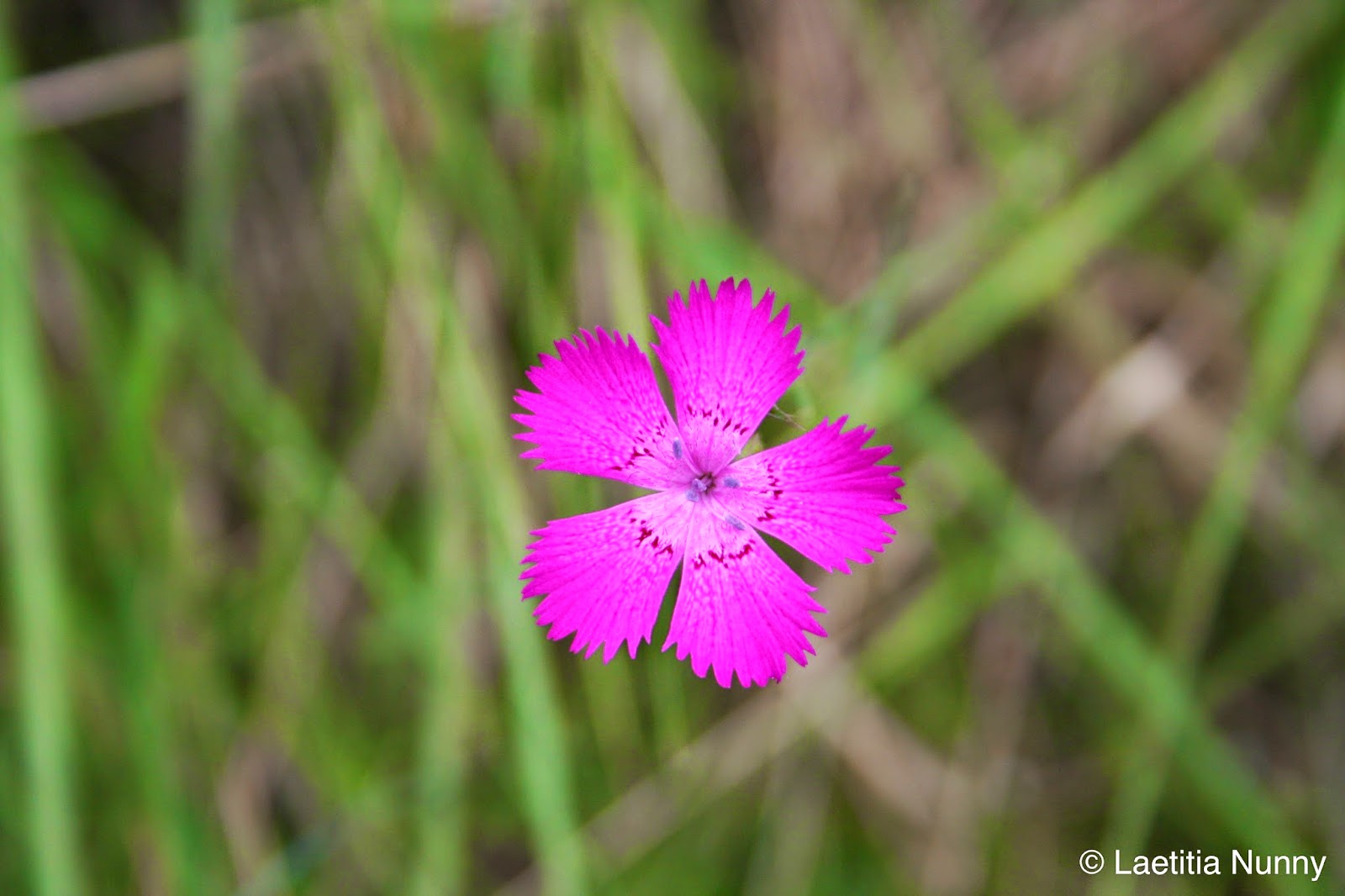 |
| Maiden pink / Clavellina (Dianthus deltoides) |
 |
| Waterfall near Santa Pau |
 |
| Beautiful scenery |
 |
| Fantastic scenery near Mieres |
Wednesday, 17 September 2014
A dark and stormy night
Last night I was awoken by the biggest thunderstorm I have witnessed since living here. That is saying something as we have a lot of storms here, far more than I ever experienced living in the south of England.
I got up to look out of the window and found that the lightning was so intense that the sky did not get dark again between flashes. It was as if the sky was white, and yet flickering constantly. Then, when the thunder sounded, a huge glaring streak of lightning would flash through the sky above the hills behind our house. Flashes so bright that they hurt my eyes and I couldn't look at them. The thunder, meanwhile, was extremely loud almost making the house shake. After a few minutes the rain arrived. Torrential rain. I was so pleased that we were safely at home and not out having to travel in it. I couldn't help thinking about the local wildlife and wondering what the animals were making of it.
This morning the river, of course, was full and flowing quickly. The world feels cleaner and brighter after a storm like that.
I got up to look out of the window and found that the lightning was so intense that the sky did not get dark again between flashes. It was as if the sky was white, and yet flickering constantly. Then, when the thunder sounded, a huge glaring streak of lightning would flash through the sky above the hills behind our house. Flashes so bright that they hurt my eyes and I couldn't look at them. The thunder, meanwhile, was extremely loud almost making the house shake. After a few minutes the rain arrived. Torrential rain. I was so pleased that we were safely at home and not out having to travel in it. I couldn't help thinking about the local wildlife and wondering what the animals were making of it.
This morning the river, of course, was full and flowing quickly. The world feels cleaner and brighter after a storm like that.
 |
| River Congost after the storm, La Garriga |
Friday, 12 September 2014
Poolside lizard
Getting out of the swimming pool at our campsite at Torroella de Montgrí, I headed back to my towel and found a little lizard sunbathing on it! He allowed me to take his photo before heading off to sit on another pool-goer's towel. I think he was a Catalonian wall lizard (Podarcis liolepis) but would be interested to hear from anyone who can confirm this for me (or give me the correct identification if I am wrong).
 |
 |
| Catalonian wall lizard / Sarganta bruna (Podarcis liolepis) |
Monday, 1 September 2014
A new book

Subscribe to:
Posts (Atom)